Hi everyone,
as promised, I’m opening this discussion to review together how SimFly currently analyzes a landing.
Over the last few days, I have reconstructed and documented in detail the current logic behind the Landing Rate, bounce detection, G-Force, Wind Bonus, and the final Landing Score.
The current logic dates back to the early stages of SimFly and has remained at the core of the landing analysis ever since.
Now I want to show you how it works as transparently as possible and discuss it with you before deciding whether anything should be changed.
I am not starting from the assumption that something is wrong.
Why I am opening this discussion
Over time, you have raised several questions about how SimFly evaluates landings.
For example, there have been cases where, on the exact same flight and in the exact same simulator, SimFly showed a different Landing Rate from another ACARS:
SimFly: -400 FPM
Another ACARS: -100 FPM
But I have also received questions such as:
“I don’t think I bounced, so why did SimFly detect a bounce?”
“Why does a bounce penalize my score this much?”
or:
“Why does a low Landing Score affect my rewards even if the rest of the flight was performed well?”
These are exactly the kinds of questions I want to address.
There is no single ACARS standard that requires every system to turn simulator telemetry into one Landing Rate in exactly the same way. The simulator provides the underlying telemetry, but each system may choose different variables, sampling moments and processing rules.
Two ACARS monitoring the same flight may therefore treat multiple contacts differently or use different averaging, filtering, sampling, or touchdown-selection logic.
For this reason, a difference such as -400 FPM versus -100 FPM, by itself, does not yet tell us which method represents the touchdown better.
Before simply comparing the final numbers, I want to show you how SimFly currently arrives at its result.
What I want to evaluate together with you
One of the main questions is whether the way SimFly currently determines the Landing Rate is the method we want to keep.
Imagine this example:
First touch: -180 FPM
→ bounce
Second touch: -420 FPM
SimFly currently applies a specific logic to the data available to it.
The attached technical document explains exactly how that logic works today.
Do you think the way SimFly currently determines the touchdown/Landing Rate is correct?
If you think it could be improved, how would you design it instead?
If you have a completely different approach, please feel free to propose it.
What about bounce detection?
This is another fundamental part of the discussion.
In the current code I reviewed, a bounce is not identified through one universal physical rule based on all wheels leaving the ground, a measured maximum bounce height, airborne time, and then a new touchdown.
The method depends on the simulator path.
On MSFS, the current logic infers bounces from changes in the touchdown values available to Analyzer.
In the X-Plane/generic path, the logic also uses a low-altitude rise condition (groundAltitude <= 3) together with the separation of data groups.
Today, the system does not calculate as dedicated bounce parameters:
- maximum bounce height;
- actual airborne duration;
- whether all wheels left the ground;
- the individual severity of every re-contact.
So I would also like to ask:
Do you think the current bounce-detection logic is appropriate?
If not, how should a bounce be defined?
Height?
Airborne time?
Wheel state?
Vertical speed at re-contact?
Severity?
A combination of several factors?
From Landing Rate to Landing Score
The FPM value is only one part of the final evaluation.
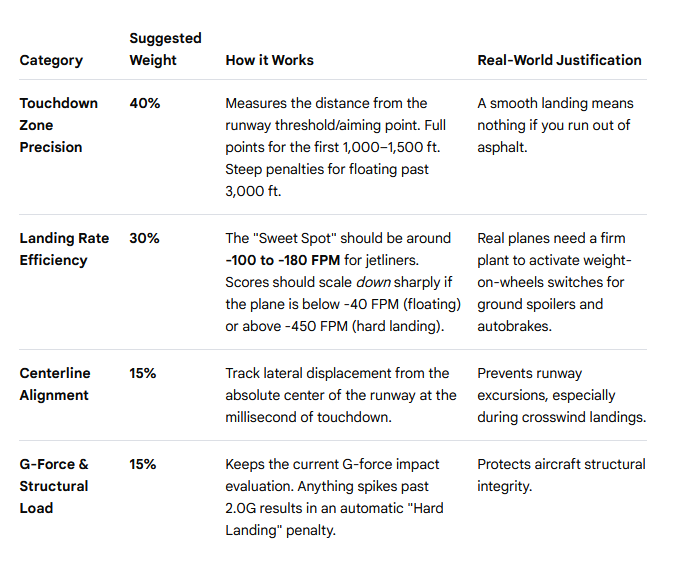
The standard Landing Score currently considers mainly:
- Landing Rate
- G-Force
- Wind Bonus
- Bounce penalty
TAS, Ground Speed and Bank Angle are displayed, but they do not directly contribute to the standard Landing Score.
Sideslip currently has no effective weight in the final score.
Very soft landings are also worth discussing: the current formula does not simply follow the rule “lower FPM is always better.”
The attached document contains the complete scoring curve and numerical examples.
The Flight Analysis Score and the Landing Score are separate values, but the Landing Score is later used in some parts of the reward calculation.
So another question I would like to discuss is:
How much should the quality of the landing really matter compared with the rest of the flight?
 Technical document attached
For anyone who wants to seriously review the logic, I am attaching a complete technical document.
It includes:
- data flow;
- simulator-specific behavior;
- touchdown selection;
- bounce detection;
- formulas;
- Landing Rate scoring curves;
- G-Force;
- Wind Bonus;
- weight-related logic;
- penalties;
- final Landing Score;
- numerical examples;
- reward impact;
- known limitations;
- what has been verified in the code;
- and what still requires runtime verification before it can be considered confirmed.
I would therefore ask you to review the document as a whole before reaching a conclusion.
The main questions I would like your feedback on are:
- Is the current way SimFly determines the touchdown/Landing Rate appropriate?
- If not, how would you design it?
- Is the current bounce-detection logic appropriate?
- How should a bounce actually be defined?
- Should height and airborne time matter?
- Should the severity of each re-contact matter?
- Should FPM and G-Force refer to the same touchdown event?
- Does the current Landing Rate scoring curve make sense?
- Should an extremely soft touchdown be penalized?
- Is aircraft weight being used appropriately in the scoring model?
- Do G-Force, Wind Bonus and bounce penalties have the right weight?
- Should TAS, Ground Speed, Bank or Sideslip influence the result?
- Is the final Landing Score constructed appropriately?
- How much should landing quality affect rewards?
You do not need to answer every question.
Please focus on the areas where you have the most experience.
And if you think an important parameter or an entirely different approach is missing, please propose it freely.
If you need more information, ask me
This is an important part of the discussion for me.
If the attached document does not contain enough information to evaluate something properly, please ask me.
If you need to understand where a particular value comes from, what the Client does with it, how Analyzer behaves in a specific scenario, or if you would like additional examples or comparisons, I will try to retrieve the necessary technical information and add it to the discussion.
The goal
I am not opening this discussion to prove that the current logic is wrong, nor to defend it simply because it is what SimFly uses today.
I want to show you how SimFly actually works today, listen to the people who use it, and understand together — with as much information as possible — whether there is a better solution.
If some parts already work in the best possible way, they will stay as they are.
If better, coherent and technically feasible ideas emerge, I will be able to evaluate and test them.
Thank you all for your help. 
Attachment: SimFly Landing Analysis — Technical Appendix
SimFly_Landing_Analysis_Technical_Appendix_EN_FINAL.pdf (520.9 KB)
If you have reached your own conclusions or have a different technical approach in mind, feel free to share it directly in the discussion. You can also attach a PDF or another supporting document if that helps explain your reasoning more clearly.